
LaRue County Court Records After Arrest
A LaRue County jail arrest usually starts with police transport to the detention center, intake, search, booking, and entry of booking charges or holds. Those jail fields can be useful, but the court record is the formal case file. Most initial criminal matters begin in district court, then prosecutor review determines whether charges stay as filed, are amended, are reduced, are dismissed, or move toward felony indictment or information. Kentucky uses county attorneys and Commonwealth's attorneys rather than a "district attorney" title, so court copy should describe a prosecutor review rather than a district attorney filing.
Use LaRue County jail inmate records for current custody, booking fields, roster status, and release clues. Use LaRue County jail mugshots when the issue is a booking photo. For filed charges, court dates, case numbers, and dispositions, the local record custodian is the circuit court clerk for the court where the case was handled. Jail charges can be only the first view of the case. Court records after a jail arrest are the better source for what the government actually filed and how the case changed over time.
Find LaRue County Court Case Records
Kentucky Court of Justice directs trial-court record requests to the circuit court clerk in the county where the case was handled. In LaRue County, that means the Office of Circuit Court Clerk for district and circuit criminal records. Online access may start with the KYeCourts guest portal, while direct local questions go to the Kentucky Court of Justice LaRue County court page or the county circuit clerk page. A portal result should still be checked against the clerk when a deadline, warrant, bond, or disposition matters.
The Kentucky court records request page states that circuit, family, district, and business court records begin with the circuit clerk where the case was heard. That is important after an arrest because the booking agency and the court are different record holders. The jail can confirm custody and bond processing, but the clerk maintains the docket, case number, hearing history, filed charges, and many final outcomes.
The official LaRue court page shows the local court contact screen used for clerk details.
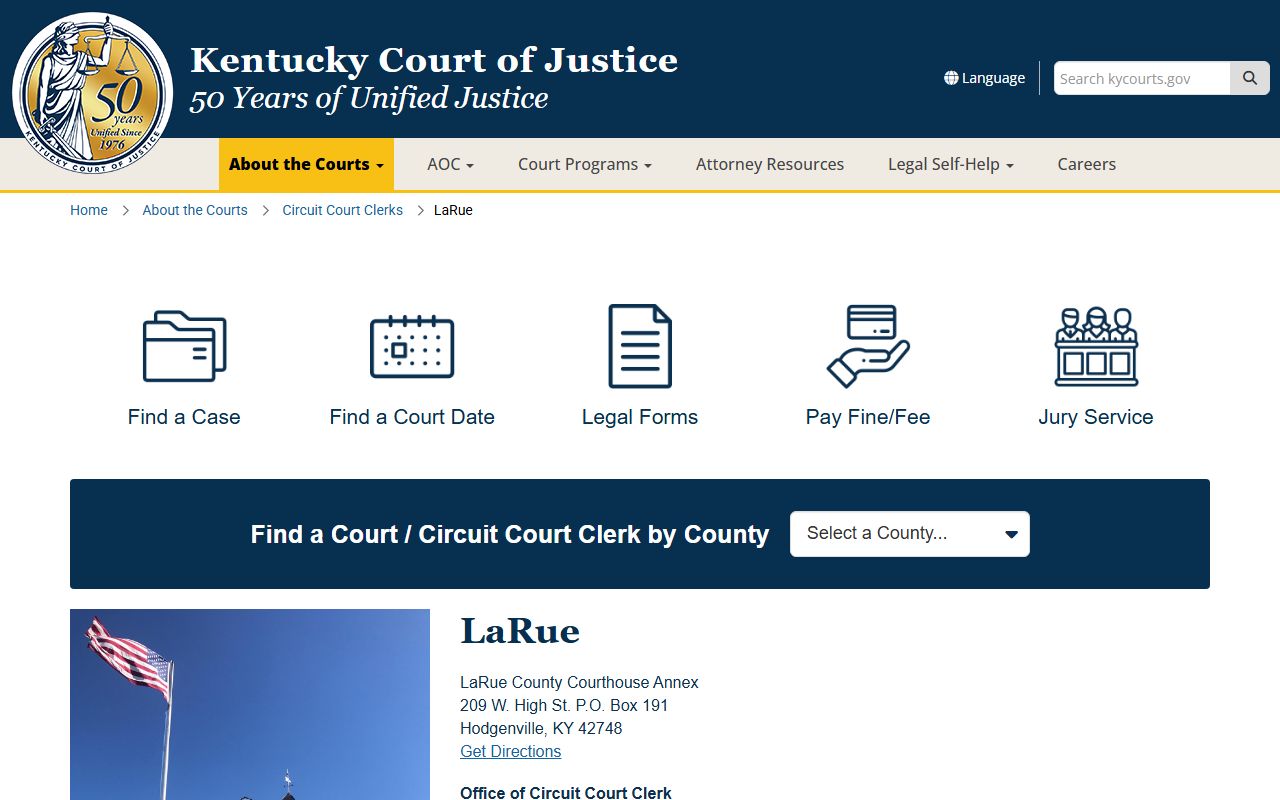
That court contact page is the better source for clerk routing than a jail roster entry when a case number, hearing date, or charge disposition is needed.
| Field Label | Type | Required | Notes |
|---|---|---|---|
| Guest login / access | Portal action | Yes | Use the KYeCourts guest login when available; portal terms apply. |
| Case number | Text | No | Best when the district or circuit case number is already known. |
| Party / defendant name | Text | No | Name spelling matters, and similar names should be checked with the clerk. |
| Citation | Text | No | Traffic and citation matters may be searchable by citation where exposed. |
| County / court | Dropdown or filter | No | Select LaRue County if the portal offers a court or county filter. |
LaRue County Arrest Charges Filed in Court
After an arrest, the booking charge is not the final word. A prosecutor may proceed by complaint, information, or indictment depending on the charge level and case path. A complaint can start many district court matters. An information is filed by a prosecutor and is often used when a felony case proceeds without grand-jury indictment. An indictment is returned by a grand jury and may replace or reshape the charge set that appeared at booking. This is why court records after an arrest can look different from the first roster screen.
| Document | Who Files It | Common Use | Why It Matters |
|---|---|---|---|
| Complaint | Officer or prosecutor | Initial district court criminal matters | Often starts the court case after arrest and booking. |
| Information | Prosecutor | Felony or negotiated case paths where allowed | Can formally charge a felony without an indictment. |
| Indictment | Grand jury | Serious felony matters | May add, amend, or replace earlier booking charges. |
LaRue County Attorney John N. Nicholas is listed by county sources as county attorney and is relevant to local prosecution and county legal matters. Felony matters can also involve the Commonwealth's attorney structure. For a reader, the practical point is simple: the court file, not the jail roster, is where the charge history and final result should be confirmed.
LaRue County Court Clerk Contact
The circuit court clerk is the local court-records contact for LaRue County criminal case files. The clerk can help route requests for district and circuit case records, docket questions, and file copies when portal access is incomplete or unclear. The county page also references a LaRue District Court Zoom link, but hearings, records, and case access should be verified with the clerk before relying on an online screen.
LaRue Circuit Court Clerk
Emily N. Ernst
LaRue County Courthouse Annex
209 W. High St., P.O. Box 191
Hodgenville, KY 42748
270-358-3421
Fax: 270-358-3731
LaRue County Charge Status Terms
Charge status is the short label that explains where a count stands. A pending charge is still unresolved. An amended charge has changed from an earlier version. A reduced charge is lowered in degree or offense level. A dismissed charge ended without conviction on that count. Some docket entries may use older legal phrasing, but the safe approach is to read the latest docket event and confirm the final disposition with the clerk.
| Status | What It Means | What to Check Next |
|---|---|---|
| Pending | The court has not reached a final result on that count. | Next hearing date, bond conditions, and active warrants. |
| Amended | The charge language, level, or count has changed. | Compare the new court count to the booking charge. |
| Reduced | The filed offense has been lowered to a lesser charge. | Look for plea terms or prosecutor action. |
| Dismissed | The count ended without conviction. | Ask whether expungement may be available. |
| Indicted | A grand jury returned a felony charging document. | Use the circuit case number and indictment counts. |
Note: A jail roster can still show old booking language after the court charge changes, so the court file controls the case history.
Bond Route After LaRue County Arrest
Bond information can appear on the jail roster, in court records, or both, but release depends on the court order and any holds. The LaRue detention center's official bond page gives a local split. During regular circuit clerk business hours, bond is paid through the LaRue County Circuit Court Clerk. The bond paperwork must then be brought to the detention center for release processing. After normal clerk hours, on weekends, and on holidays, bonds are taken at the detention center.
| Time | Where Payment Is Handled | Release Step |
|---|---|---|
| Monday-Friday, 8 am-4 pm, except holidays | LaRue County Circuit Court Clerk | Bring bond paperwork to the detention center. |
| After hours, weekends, holidays | LaRue County Detention Center | Follow the jail release process after payment or approval. |
Cash bond, surety bond, personal recognizance release, and no-bond holds are different. A cash bond uses direct payment. A surety bond usually involves a licensed bail agent. A personal recognizance release, often called PR, does not require upfront money when allowed by the court. A no-bond hold, detainer, parole hold, probation hold, out-of-county warrant, or immigration hold can block release even when one charge lists a dollar amount.
LaRue County Warrants After Arrest
No official LaRue active-warrant search was found in the research. Do not treat a commercial warrant screen as the county source. The fallback chain is local and direct: call the LaRue County Sheriff for sheriff-held warrant questions, contact the circuit court clerk for bench warrants and failure-to-appear warrants tied to a court case, call the jail if the person may already be booked, then check the current-inmates roster for a recent lodging.
Arrest warrants, bench warrants, search warrants, and fugitive warrants are not the same thing. An arrest warrant can lead to a jail booking. A bench warrant is usually tied to missing court or violating a court order. A search warrant authorizes an evidence search and is not a custody record by itself. A fugitive or out-of-county warrant can create a hold after a LaRue County arrest, which means bond on the local charge may not be enough to release the person.
Charges and Convictions in LaRue County
A charge is an accusation. A conviction is a court result after a guilty plea, trial verdict, or other adjudicated guilty outcome. This distinction is central to court records after a jail arrest because a person can be booked, charged, and later have a count dismissed or amended without a conviction on that original count. Background readers should avoid treating arrest or charge data as proof of guilt.
| Point | Charge | Conviction |
|---|---|---|
| Stage | Filed accusation after arrest or review | Final guilty outcome or plea on a count |
| Proof level | Based on charging standards such as probable cause | Requires a plea or proof beyond a reasonable doubt |
| Can change | Can be amended, reduced, or dismissed | Changes only through later court action |
| Best source | Docket, complaint, information, or indictment | Disposition, judgment, or sentencing order |
Sealed and Expunged Court Records
Kentucky open-records law starts with access. KRS 61.872 gives Kentucky residents the right to inspect public records unless an exception applies. KRS 61.876 requires public agencies to post rules and forms for public-record requests, and KRS 61.880 sets the response and denial process. Court access is not unlimited, though. Juvenile matters, sealed files, protected victim information, and exempt material may be withheld.
KRS 431.076 is the key LaRue County court-records statute for arrests that ended in acquittal, dismissal, or felony charges that did not result in indictment or information. Kentucky Court of Justice also provides expungement certification information for people checking eligibility. Expungement is a court process, so the clerk and court forms matter more than the jail roster.
| Record State | Public Visibility | Practical Effect |
|---|---|---|
| Sealed | Hidden from ordinary public access | May remain available to courts or agencies in limited settings. |
| Expunged | Removed from public view under the court order | Treated as cleared for many public-record purposes. |
| Not eligible | Usually remains accessible unless another rule applies | Check the disposition, statute, and waiting rules. |
Important: Public case lookup is not a consumer report and must not be used for credit, employment, insurance, tenant screening, or any other FCRA-covered decision.